


Living in Italy vs America is one of the biggest questions people ask when comparing cost of living, jobs, and overall quality of life.I got the alert on my phone while shopping in Rome: my former Brooklyn landlord was jacking up the rent to $3,200 for the same shoebox apartment I’d vacated.
Meanwhile, I stood in a centuries old neighborhood paying €850 for double the space and a balcony overlooking a piazza. And that’s what I realized the Italy vs USA cost of living is not only about numbers. It’s about what you can actually get for those numbers in the quality of life.
So after living in both countries (including helping dozens of friends work their way through their own moves across the Atlantic), I’ve come to see that the “which is cheaper” question is completely beside the point.
What you’re really asking is: where can your money and the rest of your life take you further? Let’s get to the real numbers, the hidden costs and the lifestyle trade-offs that nobody tells you about until you’re already in it.
Housing Costs: Renting in Italy vs USA
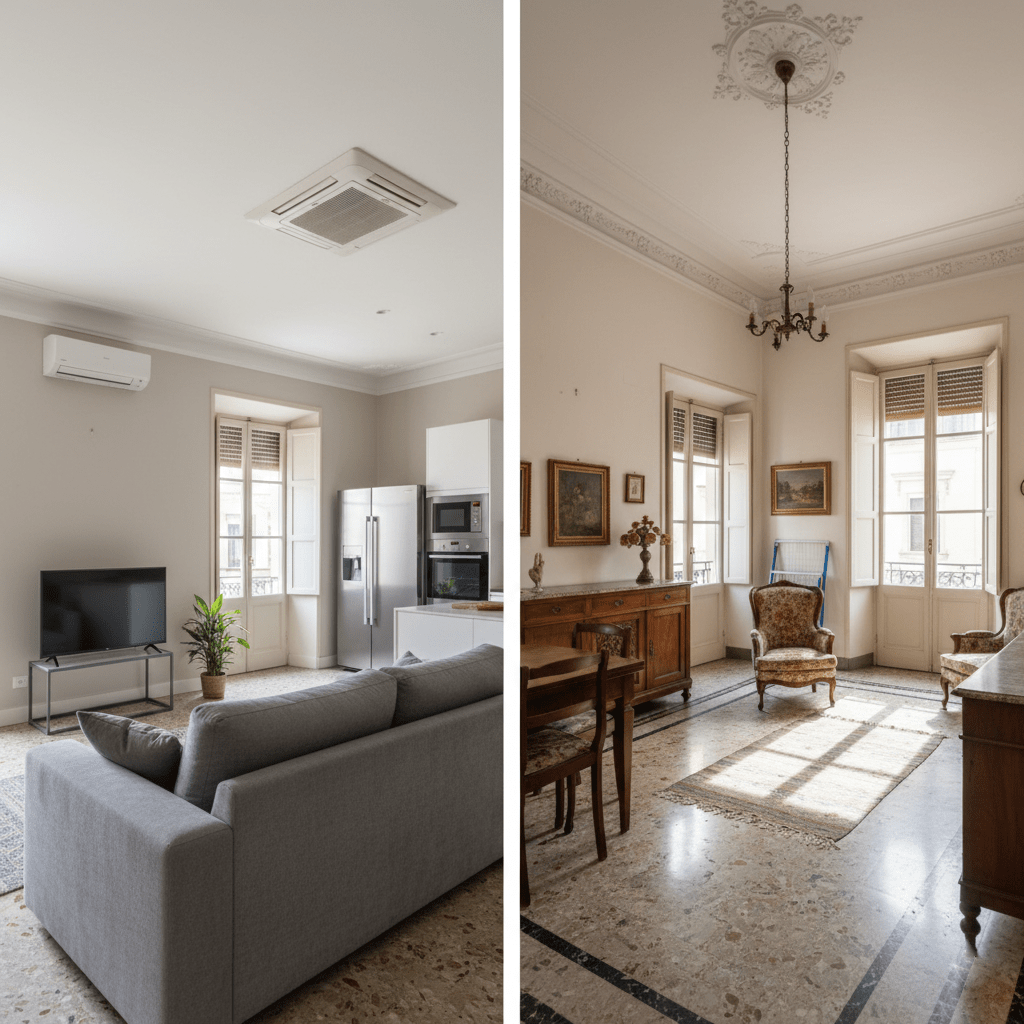
Renting in Italy vs USA
The cost to rent an apartment in Italy can be a roller coaster ride compared to where you are, but here’s what you’re really in for come 2026. In a big city, such as Milan or Rome, that could mean spending €1,200-€1,900 ($1,300-$2,060) a month for a one-bedroom apartment in an enjoyable neighborhood.
By December 2025, Milan’s average rent was of €22.8 per m² – therefore, you would pay on average €1,824 for an 80 m² apartment in the city. Head to mid-sized cities such as Bologna, Turin or Naples, and that figure falls to €700-1,100 ($760-1,195). Small towns and southern Italy? You could find decent places for €400–700 ($435–760).
The quality differences matter too. Italian apartment units have shiny marble floors, soaring ceilings and historic character, but central heating can be minimal at best, air conditioning is an anomaly and closet space is paltry by American standards. We Americans are much more likely to have all the modern appliances, climate control and storage space of European rentals, but you know what we don’t usually offer?
Buying Property: Long-term Investment Comparison
Outside of Italy’s major cities, property prices can be surprisingly affordable.Expect €2,000-4,000 per square meter in cities like Florence or Verona, dropping to €1,000-2,000 in smaller towns. The Italian south offers even better deals; you’ve probably seen those “€1 houses” programs in Sicily or Molise (though renovation costs are substantial).
The American housing market in 2026 remains challenging for first-time buyers. According to recent data, the median home price is approximately $274,000 nationally (although this varies dramatically by region), with desirable markets significantly higher.The advantage? American mortgages are more affordable, property taxes are generally deductible, and the resale market is more liquid. Italian real estate transactions involve higher notary fees, longer closing times and a less fluid market.
Salaries & Employment: The Income Reality Check

This is where America’s financial advantage becomes stark. Let’s compare typical annual salaries across common professions in 2026:
Software Developers: Italy €30,000-45,000 ($33,000-49,000) vs USA $95,000-145,000
Teachers: Italy €25,000-35,000 ($27,000-38,000) vs USA $45,000-70,000
Nurses: Italy €24,000-36,000 ($26,000-39,000) vs USA $65,000-90,000
Marketing Managers: Italy €35,000-55,000 ($38,000-60,000) vs USA $75,000-115,000
Engineers: Italy €31,000-50,000 ($34,000-55,000) vs USA $80,000-135,000
Before you dismiss Italy based on these numbers, remember that Italian salaries come with significantly lower healthcare costs, more vacation time, and stronger job protections. The American salary premium often evaporates when you factor in health insurance ($500-800 monthly), minimal paid time off (10-15 days versus Italy’s 4-5 weeks), and at-will employment that offers zero job security.
Job Market and Opportunities
The American job market offers more positions, faster hiring processes, and greater career mobility. You can switch industries more easily, and the startup culture creates opportunities that simply don’t exist in Italy’s more traditional business environment.
English fluency opens nearly every door in the US job market.
Italian job market is difficult. On the downside, youth unemployment is about 20%, and finding meaningful employment in Italy without Italian-speaking ability will confine you to tourism, teaching English and international firms.
But one you find a job, Italian employment law really provides strong protection against being fired at whim, “mandatory” severance (TFR), and pension contributions that matter.
Healthcare Costs: Italy vs USA
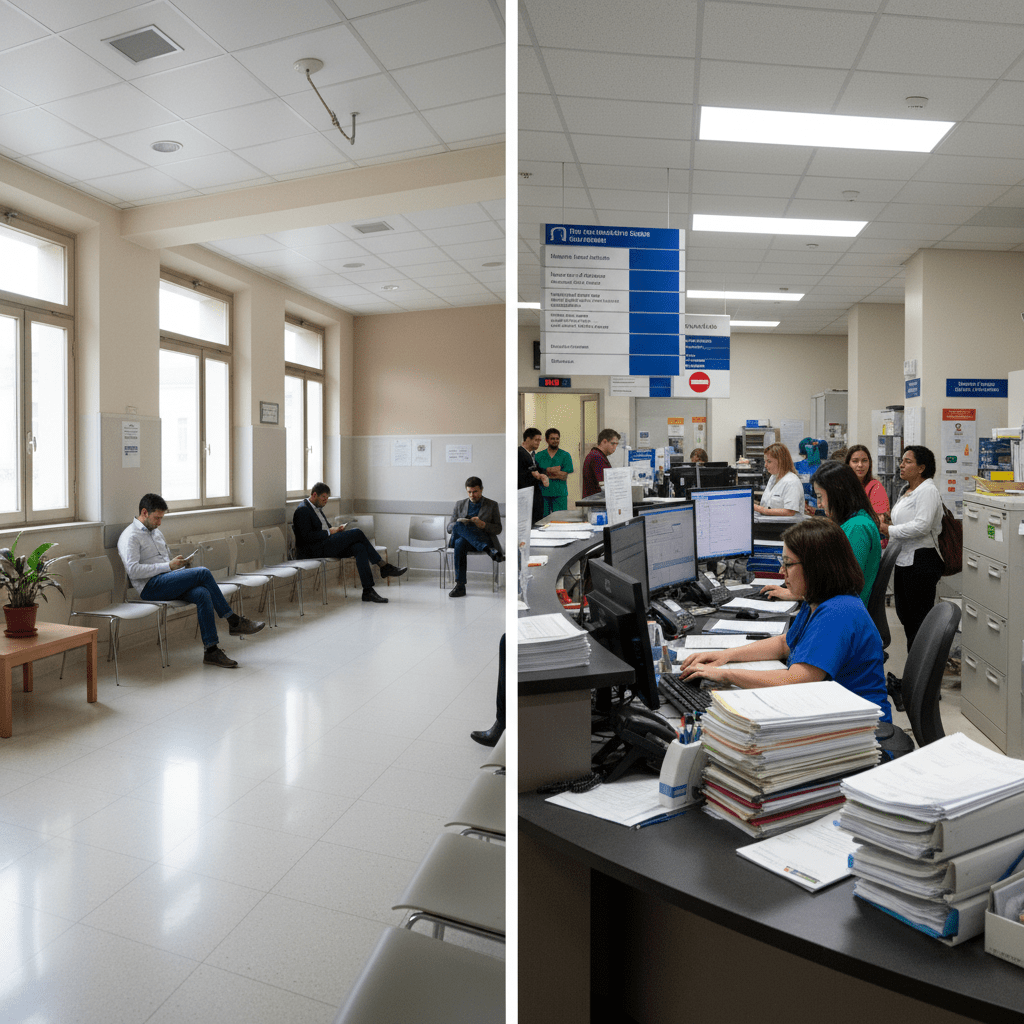
Italian National Health Service (SSN)
Italy’s public healthcare system is where the country genuinely excels. As a legal resident, you’ll register with the SSN and receive comprehensive coverage for a small annual fee (typically €0-400 depending on your region and income). Doctor visits cost nothing. Emergency care is free. Surgery, cancer treatment, and chronic disease management? All covered.
Prescription medications in Italy cost €0-10 for most common drugs, with prices capped by the government. Even without SSN coverage, seeing a private doctor costs €80-150, and private insurance runs €1,000-2,500 annually for comprehensive coverage—a fraction of American costs.
The tradeoffs? Waiting times for nonemergency procedures can be months. Specialist appointments may not be available for weeks. Many Italians take hybrid approaches, turning to public health for serious issues and paying on their own for access that is faster to routine care.
American Healthcare System
American healthcare remains the most expensive in the developed world in 2026. Even with employer-sponsored insurance, you’re paying $250-700 monthly in premiums, facing deductibles of $1,800-7,000 before insurance covers anything, and hitting out-of-pocket maximums of $6,000-10,000 for individuals.
Without employer coverage? Plans on the individual market range $450-1,400 per month and have similar deductibles. A visit to an emergency room can result in bills ranging from $3,500 to $12,000. All in all, paying for health care eats up about $13,500-15,000 a year per household now between premiums and deductibles and out-of-pocket costs.
The American advantage is immediate access and cutting-edge treatment options. If you need a specialist, you’ll see one within days.Medical facilities are modern,staff-to-patient ratios are better, and experimental treatments are more readily available.
Daily Living Expenses: Food, Utilities, and Transportation

Good old American groceries may be expensive, but they are convenient and varied. Plan on spending $350-550 a month per person for similar caliber. In 2026, the typical U.S. household will spend about $7,317 on food a year ($610 a month), with differences based largely on where people live and what foods they prefer to eat. The American edge is ready access to ethnic foods, late-opening stores and the ability to buy in bulk, a practice that does not exist in many Italian cities.
Dining out showcases Italy’s value proposition. A legitimate margherita pizza costs €6-10,a complete lunch menu (prima, secondo, side dish, water)costs €12-18, an aperitif with snacks costs €8-12 and an espresso costs €1-1.50. In American cities, you pay $15-25 for pizza, $25-40 for a modest lunch, $12-18 for a cocktail,and $4-6 for coffee.
Utility Bills and Internet
How dear IS Italian electricity Figure on €80-150 a month for average apt., more if you use air conditioning (which is not common). Gas for heating and cooking costs an extra €30-80 per month. Water is cheap at €20-40. Combined Internet and mobile service is €30-50/mo for decent speeds/access, unlimited (within reason) data. Total monthly utilities: €160-270 ($175-295).
American utilities vary dramatically by region.Budget $100-200 for electricity (including AC in summer), $50-150 for gas (higher in cold climates), $30-70 for water, and $60-120 for internet plus mobile. Total: $240-540 monthly, averaging around $350 for most Americans.
Transportation Costs
In Italy, public transit is cheap and it works. Monthly passes are surprisingly affordable (€35-55 in most cities)._^(And actually living without a car is not unreasonable, once you keep the numbers local.) If you do have a car, be ready for high gas prices (€1.70-2.00+ per liter), scarce parking availability, ZTL limitation in historic centers and annual insurance between €500-1,200 depending on age and driving history.
America is car-dependent outside major cities.You’ll need a vehicle, which means car payments ($300-600), insurance ($100-250),gas($150-250), maintenance ($100-200),and parking ($50-200 in cities). Total monthly transportation costs in America: $700-1,500.Public transit exists primarily in NYC, Chicago, DC, and San Francisco but remains limited compared to European standards.
Taxes: The Hidden Impact on Take-home Pay

Italian Tax System
America needs the car outside of big cities. You’ll need a car (which means car payments, $300–600; insurance, $100–250; gas, $150–$250; maintenance, $100–200; and parking, at large cities $50–200). Average monthly transportation costs in America: $700–1,500. Public transportation is confined to New York, Chicago, DC and San Francisco but even those are paltry compared to Europe.
The upside? Those taxes fund universal healthcare, generous unemployment benefits, pension systems, and paid parental leave. Your net salary may be lower, but your baseline security is significantly higher.
American Tax StructureFederal income tax brackets in the US range from 10 per cent to 37 per cent, with most middle class earners paying between 22 and 24 percent. State income tax adds 0-13%, depending where you live (none in Texas and Florida; 9%-13% in California and New York). The payroll tax for Social Security and Medicare is 7.65% of paychecks.
Americans keep more of their gross salary, but that money must cover healthcare, retirement savings, emergency funds, and shorter periods of unemployment support. The take-home advantage is real, but so is the financial vulnerability.
Quality of Life: What Money Can't Measure

Work-Life Balance and Vacation Time
Italian work culture prioritizes life over work in ways that still shock Americans. The standard workweek is 38-40 hours, lunch breaks are sacred (often 1-2 hours), and taking your full vacation allowance (4-5 weeks minimum) isn’t just accepted—it’s expected. August essentially shuts down as entire companies close for Ferragosto. Parental leave is generous, sick days are
protected, and nobody glorifies burnout.
American work culture is productivity-obsessed. The standard workweek is 40 hours officially but often 50+ in practice. Lunch is eaten at your desk. Vacation time starts at 10 days annually, one of the lowest among developed nations, and using it all can feel like career sabotage. Parental leave is minimal and often unpaid. The hustle culture is real, exhausting, and financially rewarding for some.
Social Life and Community
Italy’s social fabric revolves around face to face interaction. The piazza culture means people gather physically, meals are multi-hour affairs, and your local shopkeepers know your name. Making genuine Italian friends takes time and integration is slow but deep. Family ties are intense,sometimes suffocatingly so.
American social life is faster, more casual and friendly. Making friends is easy; Building deep friendships requires intentional effort. The advantage is flexibility – you can reinvent yourself, move freely and build a chosen family without judgement. The downside is isolation if you don’t actively cultivate community.
Cultural and Lifestyle Differences
Italy offers beauty and history at every corner, a food culture that’s both sophisticated and accessible, and a slower pace that forces you to savor moments. The bureaucracy will drive you insane, efficiency is not a priority, and change happens glacially.
America offers convenience, diversity and innovation.You can receive anything at any time, follow any lifestyle without judgment, and access world-class museums, parks, and entertainment.Car dependency is real, commercialism is exhausting, and inequality is impossible to ignore.
The Bottom Line: Which Country Wins?

The honest answer? It depends entirely on what you value and which life stage you’re in.
Choose Italy if you:
- Value healthcare security over maximum earnings
- Want work-life balance and actual vacation time
- Appreciate slow living and daily beauty
- Can navigate bureaucracy with patience
- Speak or will learn Italian
- Prefer public transit and walkable cities
Choose the USA if you:
- Prioritize career growth and earning potential
- Value convenience and efficiency
- Need diversity and cultural options
- Want geographic and career mobility
- Prefer material comfort and modern amenities
- Can manage without comprehensive healthcare
Neither choice is objectively better.Italy offers security, beauty, and balance at the cost of opportunity and dynamism. America offers income, ambition, and possibility at the cost of security and social cohesion.
The real truth? After years in both countries, I’ve learned that you’ll miss whichever place you leave. And that means both have something genuinely worth experiencing.
Frequently Asked Questions (FAQ)
Is Italy cheaper than the USA to live?
Yes, Italy is generally cheaper than the USA for rent, healthcare, public transportation, and daily food especially outside major cities like Milan. However, salaries in Italy are much lower than in the US, which affects overall affordability.
Is the cost of living lower in Italy than in America?
For everyday expenses such as groceries, dining out, and healthcare, Italy usually has a lower cost of living than America. Housing in large Italian cities can be expensive, but still often cheaper than major US cities like New York or San Francisco.
Do people earn less in Italy than in the USA?
Yes. Salaries in Italy are significantly lower than in the USA across most professions. However, Italians receive more vacation time, stronger job protections, and far lower healthcare costs.
Is healthcare free in Italy for foreigners?
Legal residents in Italy can access the public healthcare system (SSN) for a low annual fee. Most medical services, including emergency care and hospital treatment, are free or very low-cost compared to the US.
Is the quality of life better in Italy or the USA?
It depends on personal priorities. Italy offers better work-life balance, healthcare security, and slower living. The USA offers higher income potential, convenience, and career mobility.
Can Americans legally work in Italy?
Yes, but Americans need a valid work visa or residency permit. Finding a job without speaking Italian can be difficult, except in fields like tech, teaching English, or international companies.
Is it easier to live without a car in Italy or the USA?
Italy is much easier to live in without a car due to affordable public transportation and walkable cities. In most parts of the USA, owning a car is essential.
Which country is better for saving money, Italy or the USA?
The USA is better for saving money if you earn a high salary and manage expenses carefully. Italy is better for financial stability, with lower healthcare costs and fewer unexpected expenses.
Is moving to Italy worth it financially?
Moving to Italy can be financially worth it if you value healthcare security, lifestyle, and lower daily costs over high income and fast career growth.